
Before referring a patient for non-emergency medical transportation, discharge planners should confirm three things. First, the provider must match the patient’s actual level of mobility. Second, it must arrive when the discharge is ready. Third, its staff should take the patient all the way from the bedside to the destination’s door. Get those right and the ride becomes the easiest part of the discharge, not the reason it stalls.
Here’s a practical guide for discharge planners, case managers, and social workers across Northern Virginia.
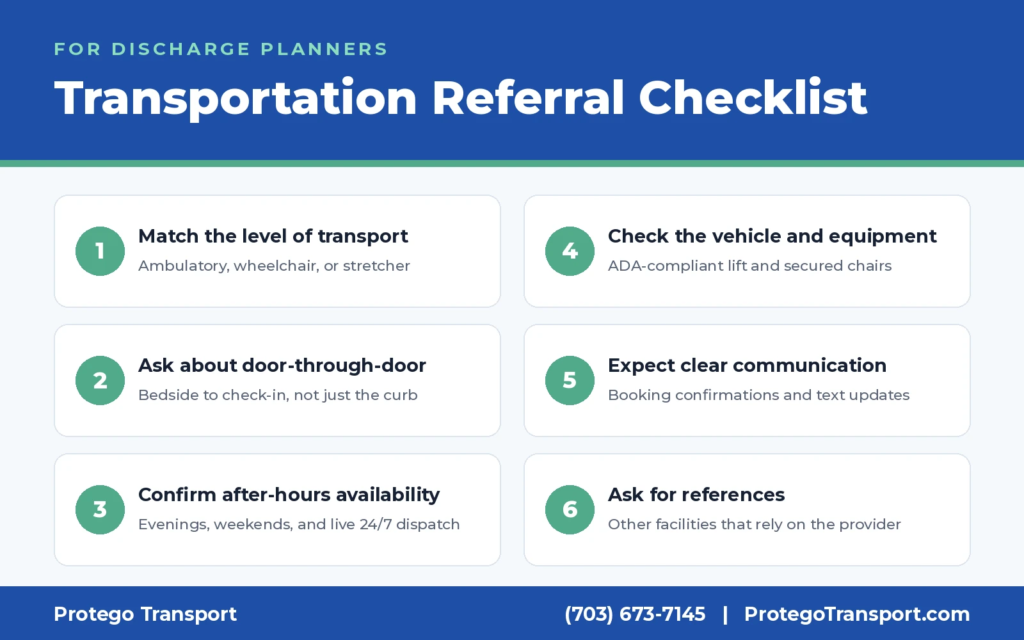
What Discharge Planners Need From a Transportation Partner
Discharge planning is about predictability. The unit needs the bed, and family members are coordinating around the pickup. Meanwhile, the receiving location expects the patient at a certain time, whether that’s home, assisted living, or rehab. In addition, federal discharge-planning rules emphasize patient preferences and a safe transition between settings. The federal discharge planning fact sheet explains those rules. In other words, transportation is the physical link in that transition.
1. Match the Level of Transport to the Patient, Not the Paperwork
Most transportation problems at discharge start with the wrong level of service. For example, a patient who walked in may leave far weaker after surgery. Similarly, someone who can sit for ten minutes may not tolerate a long ride upright. Before calling, discharge planners should confirm whether the patient needs ambulatory, wheelchair, or stretcher transport. Also share anything that affects the transfer, such as weight, oxygen, isolation status, or a second assistant. Our guide on choosing the right level of transport walks through the differences. In addition, our post on stretcher transport home from the hospital covers patients who cannot sit up safely.
2. Ask Whether the Service Is Curb-to-Curb or Door-Through-Door
This is the question that separates providers. Curb-to-curb service waits at the entrance. As a result, a nurse or aide often has to bring the patient down. Someone also has to meet them at the other end. Door-through-door service, on the other hand, means trained staff come to the patient’s room. They assist with the transfer into the vehicle, then escort the patient all the way inside at the destination. That means through check-in, not just to the curb. For a frail or post-operative patient, that difference is a safety issue. We explain it in detail in Curb-to-Curb vs. Door-Through-Door.
3. Confirm Availability Outside Business Hours
Discharges don’t keep office hours. Orders often come late in the afternoon, and weekend discharges are common. Because of that, a delay of a few hours can mean another night in a bed the unit needs. So ask whether the provider has dispatch available 24/7. Discharge planners should also be able to book evening or weekend rides with a live person, not a voicemail.
4. Look at the Vehicle and the Equipment
Wheelchair and stretcher patients need ADA-compliant vehicles with a proper lift, not a ramp improvised at the curb. Therefore, ask what the provider drives. Also ask how the crew secures wheelchairs and stretchers during the ride.
5. Make Sure Communication Takes Work Off Your Plate
A good transportation partner reduces calls to your desk. For that reason, look for a provider that confirms the booking right away. It should also update the patient and family by text as the ride approaches. In addition, it should tell discharge planners as soon as there’s a change. Finally, ask how the provider handles patient information. A professional partner should request only what the trip requires and keep it private.
6. Ask Other Discharge Planners and Facilities for References
The best evidence of reliability is another facility that already relies on the provider. For example, Protego Transport is a member of the United Medical Transportation Providers Group. We also have reference letters from senior living and skilled nursing partners, available on request.
How Protego Transport Supports Discharge Planners
Protego Transport provides ambulatory, wheelchair, and stretcher transportation throughout Loudoun, Prince William, Fairfax, and Arlington counties. We also offer long-distance trips across Virginia and to destinations beyond it. Every ride is door-through-door. That is, our trained staff meet the patient in their room, handle the transfer, and escort them to check-in. Our dispatch is available 24/7, and our lift-equipped Ford Transit vehicles are ADA-compliant. We also send text updates so families know exactly when we’re arriving. The goal is simple: take the transportation workload off your team so you can focus on the discharge itself. If you’re helping a family directly, share our guide to hospital discharge transportation in Northern Virginia with them.
Have a patient ready for discharge, or want to set up a referral relationship for your unit? Call us at (703) 673-7145 any time, day or night. We’re happy to answer questions, talk through a specific transfer, or give you an exact quote.
Ready to refer a patient? Our hospital discharge transportation service covers same day and scheduled discharges.
Protego Transport — Where care meets mobility.